
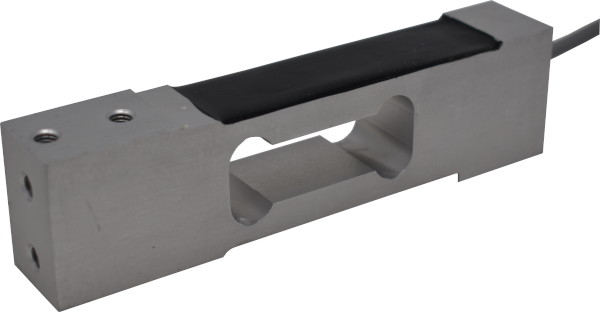
Off-center load cell TA9
Download PDF datasheet
Off-center load cell for weighing systems, automatic dosage machines, medical, food, textile, and automation in general
Off-center load cell
Upon request with certification ATEX or IECEx.
Omologated C3 OIML.
Click on the image to enlarge
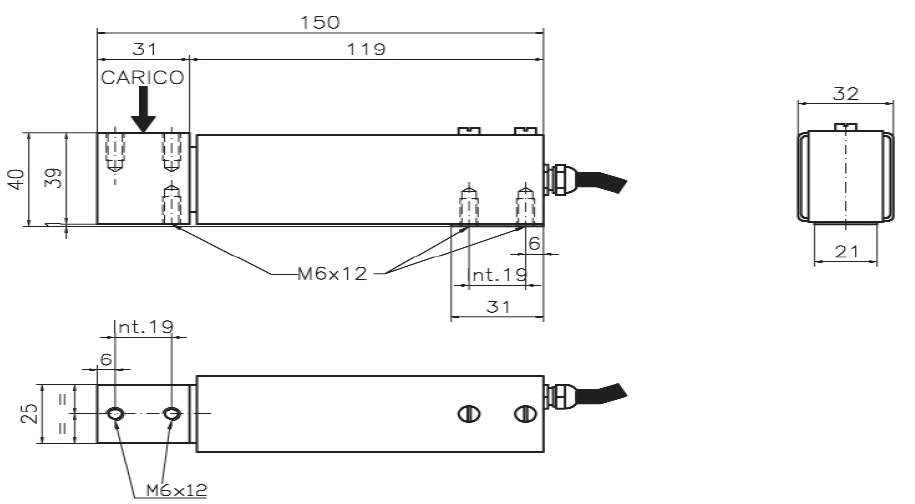



Technical specifications
| Material | Aluminium |
|---|---|
| Nominal load | 5, 10, 20, 30, 50, 100 kg |
| Limit load | 150 % F.S. |
| Breaking load | 300 % F.S. |
| Supply voltage | Vcc 15 Max |
| Output | 2 mV/V |
| Output tollerance | 0,1 % F.S. |
| Zero tollerance | 1 % F.S. |
| Linearity | 0,03 % F.S. |
| Hysteresis | 0,03 % F.S. |
| Reapeatability | 0,03 % F.S. |
| Input resistance | 400-412 ohm |
| Output resistance | 350-353 ohm |
| Insulation resistance | >= 5000 Mohm |
| Creep (30 Minutes) | 0,03 % F.S. |
| Thermal compensation | -10 / +40°C (14 / +104°F) |
| Operating temperature | -20 / +70°C (-4° / +158°F) |
| Temperature deviation zero | 0,003 % F.S. / °C |
| Temperature deviation full scale | 0,002 % F.S. / °C |
| Protection class | IP 65 |
| Standard cable length | 3 m – 6C (shield not connected to the load cell body) |
For complete and up-to-date technical specifications please refer to the datasheet you can download here
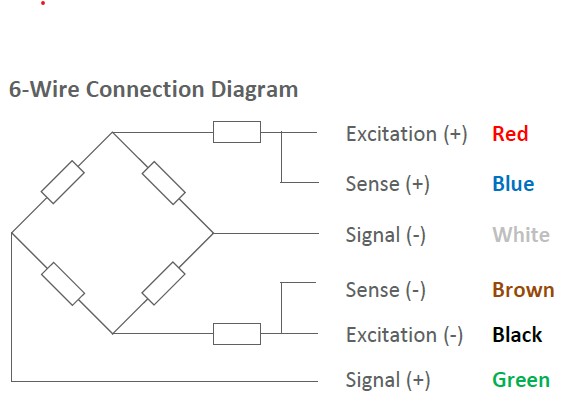
Download PDF datasheet Connections
| Type | SHIELDED CABLE 6C R5 PVC |
|---|---|
| Length | 3 mt (shield not connected to the cell body) |
| Red | + IN |
| Black | - IN |
| Green | + OUT |
| White | - OUT |
| Blue | + REF |
| Brown | - REF |
Load cell mounting
General guidelines for installing and mounting load cells:
- Respect the direction in which forces are applied to the load cells
- Do not exceed the temperature limits shown on the rating plate
- Do not remove the labels from the cells
- Protect cables properly with sheaths or cable ducts
- Connect each cell to earth with a suitable cable, bridging the plates of the mounting accessories if necessary
- Do not weld on the mechanical structure once the cells are in place
- Avoid or minimise mechanical constraints between the fixed structure and the weighed structure, to prevent weighing errors and zero return problems
- When vibrations or dynamic loads are present, protect the cells with anti-vibration mounts
- Protect the cells from dust build-up with suitable covers